Article Publishing History Article Received on : 03 May 2025 Article Accepted on : 05-August 2025 Article Published : 01 Sep 2025 Plagiarism Check: Yes Reviewed by: Dr. Shilpa Sindhu Second Review by: Dr. Riddhi Patel Final Approval by: Prof. Navneet Kaur
Article Metrics
ABSTRACT:
The integration of Artificial Intelligence (AI) into the Internet of Things (IoT) ecosystem has transformed the landscape of cybersecurity. While IoT systems enable ubiquitous connectivity and automation across industries, they are also highly susceptible to cyberattacks due to their heterogeneity, limited resources, and scalability challenges. AI-based techniques, including machine learning, deep learning, and reinforcement learning, offer promising approaches to detecting anomalies, preventing intrusions, and predicting emerging threats in IoT networks. However, these opportunities are accompanied by significant challenges such as adversarial attacks, data privacy concerns, computational limitations, and the interpretability of AI models. This review article critically analyzes the dual role of AI in IoT security, highlighting its potential as both a defender and an enabler of cyber threats. Various AI-driven techniques are systematically reviewed, their applications in IoT security are discussed, and emerging risks are evaluated. The article further identifies future directions, emphasizing the importance of explainable AI, lightweight security frameworks, and robust adversarial defense mechanisms for sustainable and resilient IoT ecosystems.
KEYWORDS:
Artificial Intelligence, Internet of Things, IoT Security, Machine Learning, Deep Learning, Anomaly Detection, Cybersecurity, Adversarial Attacks
Copy the following to cite this article:
Fasel Qadir. Artificial Intelligence in IoT Security: Uncovering Opportunities and Threats Orient.J. Comp. Sci. and Technol; 17(1).
Copy the following to cite this URL:
Fasel Qadir. Artificial Intelligence in IoT Security: Uncovering Opportunities and Threats Orient.J. Comp. Sci. and Technol; 17(1). Available on. http://bit.ly/4mUo8lu
Introduction
The Internet of Things (IoT) has emerged as a transformative technology, enabling billions of interconnected devices to exchange data and deliver intelligent services in healthcare, transportation, smart homes, and industrial systems. However, the very features that make IoT powerful—ubiquity, decentralization, and heterogeneity—also make it vulnerable to cyber threats. Attacks such as Distributed Denial-of-Service (DDoS), man-in-the-middle, spoofing, and ransomware have exposed the inadequacy of conventional security models in handling the scale and complexity of IoT.
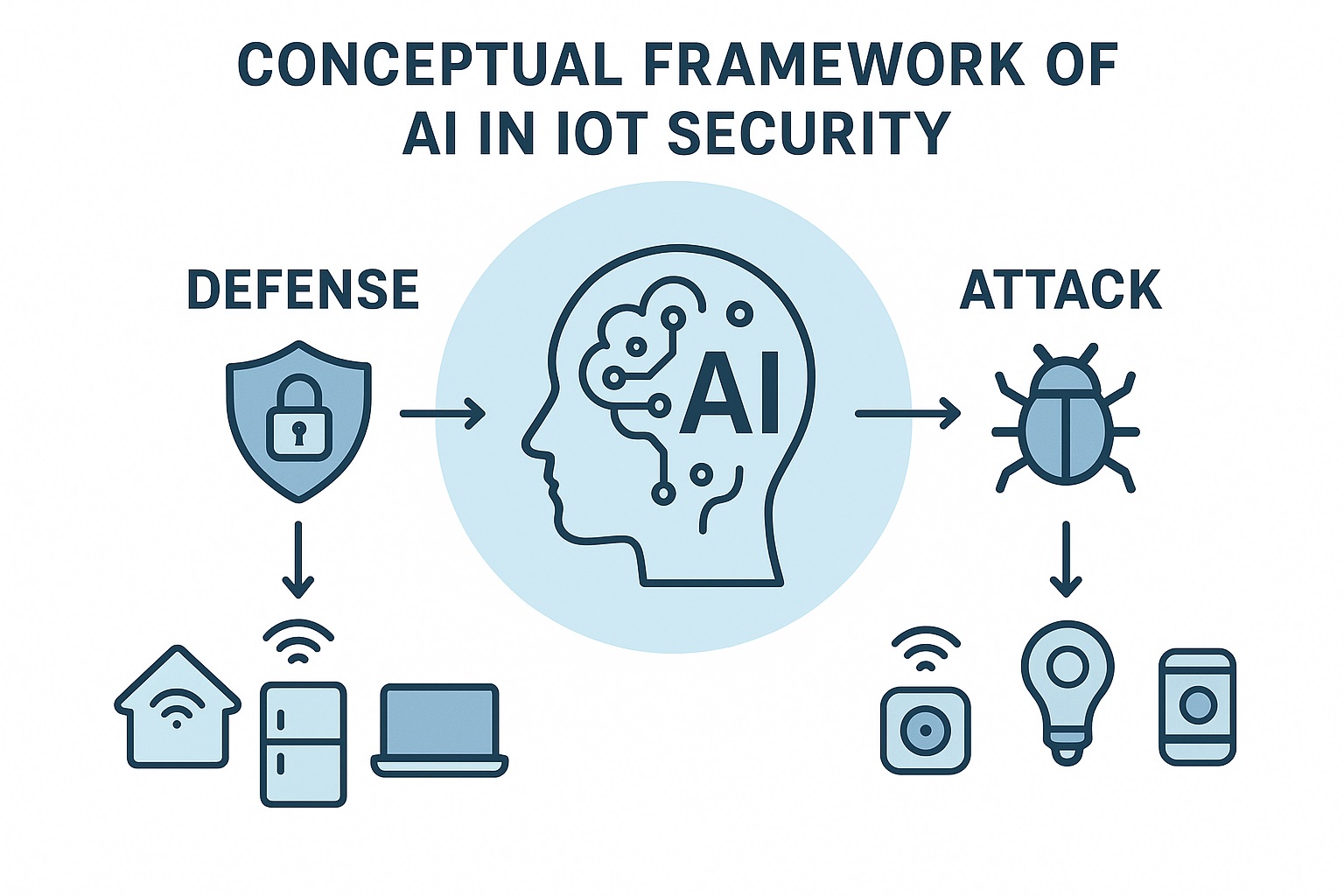
Artificial Intelligence (AI) has gained prominence as a security enabler, capable of analyzing massive streams of IoT data, detecting anomalies in real time, and adapting to evolving attack patterns. Machine learning (ML) and deep learning (DL) models have been applied to intrusion detection, malware classification, and traffic analysis. At the same time, AI introduces new vulnerabilities, such as adversarial attacks on ML models, data poisoning, and algorithm manipulation. This dual role of AI creates a paradox: while it strengthens IoT defense mechanisms, it simultaneously equips adversaries with sophisticated attack tools.
This article reviews the opportunities and threats of AI in IoT security. It provides an in-depth analysis of AI-driven defense mechanisms, potential risks, and research gaps, aiming to guide future PhD-level research in building trustworthy and explainable AI-based IoT security solutions.
Material and Methods
This review adopts a systematic literature review methodology. Scholarly articles published between 2016 and 2025 were collected from IEEE Xplore, SpringerLink, ScienceDirect, ACM Digital Library, and Scopus databases. Keywords such as AI in IoT security, machine learning for IoT cybersecurity, adversarial AI IoT, and anomaly detection IoT were used.
Inclusion criteria:
Peer-reviewed articles and conference papers.
Studies focusing on AI techniques applied to IoT security.
Publications addressing both opportunities and threats.
Exclusion criteria:
Articles not related to IoT or AI.
General cybersecurity studies without IoT-specific context.
A total of 145 articles were screened, of which 62 were selected for final analysis. The extracted data were categorized into AI opportunities, threats, and hybrid perspectives.
Results and Discussion
Opportunities of AI in IoT Security
AI provides robust mechanisms to enhance IoT security:
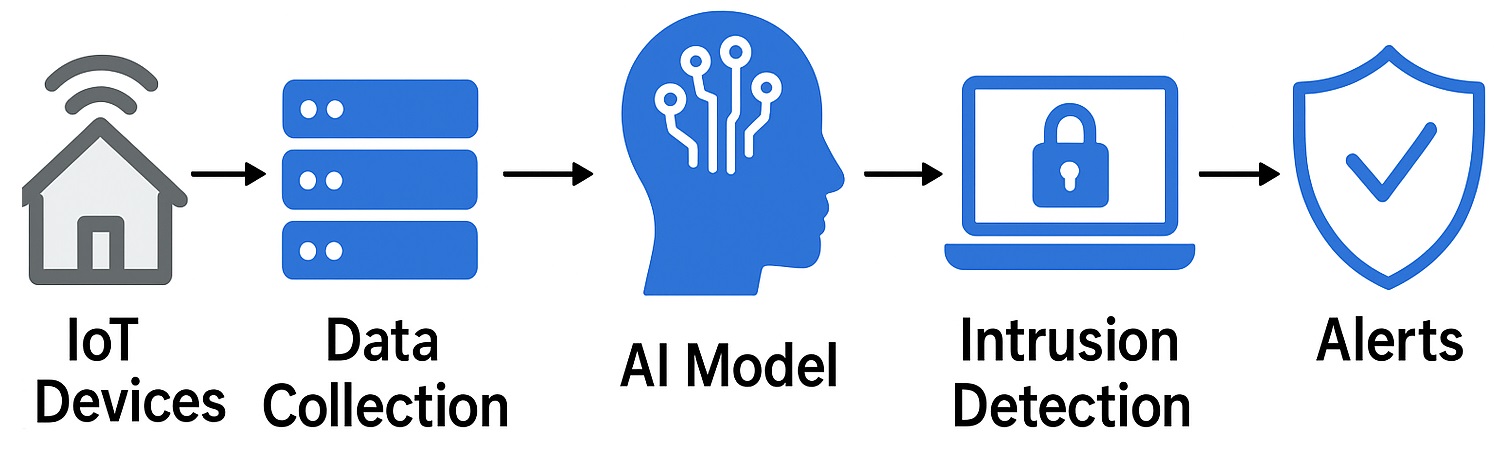
Anomaly Detection: ML models detect abnormal device behaviors in real-time IoT traffic.
Intrusion Detection Systems (IDS): DL architectures (CNN, RNN, LSTM) identify malware and intrusion attempts.
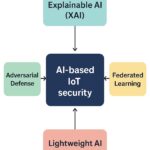
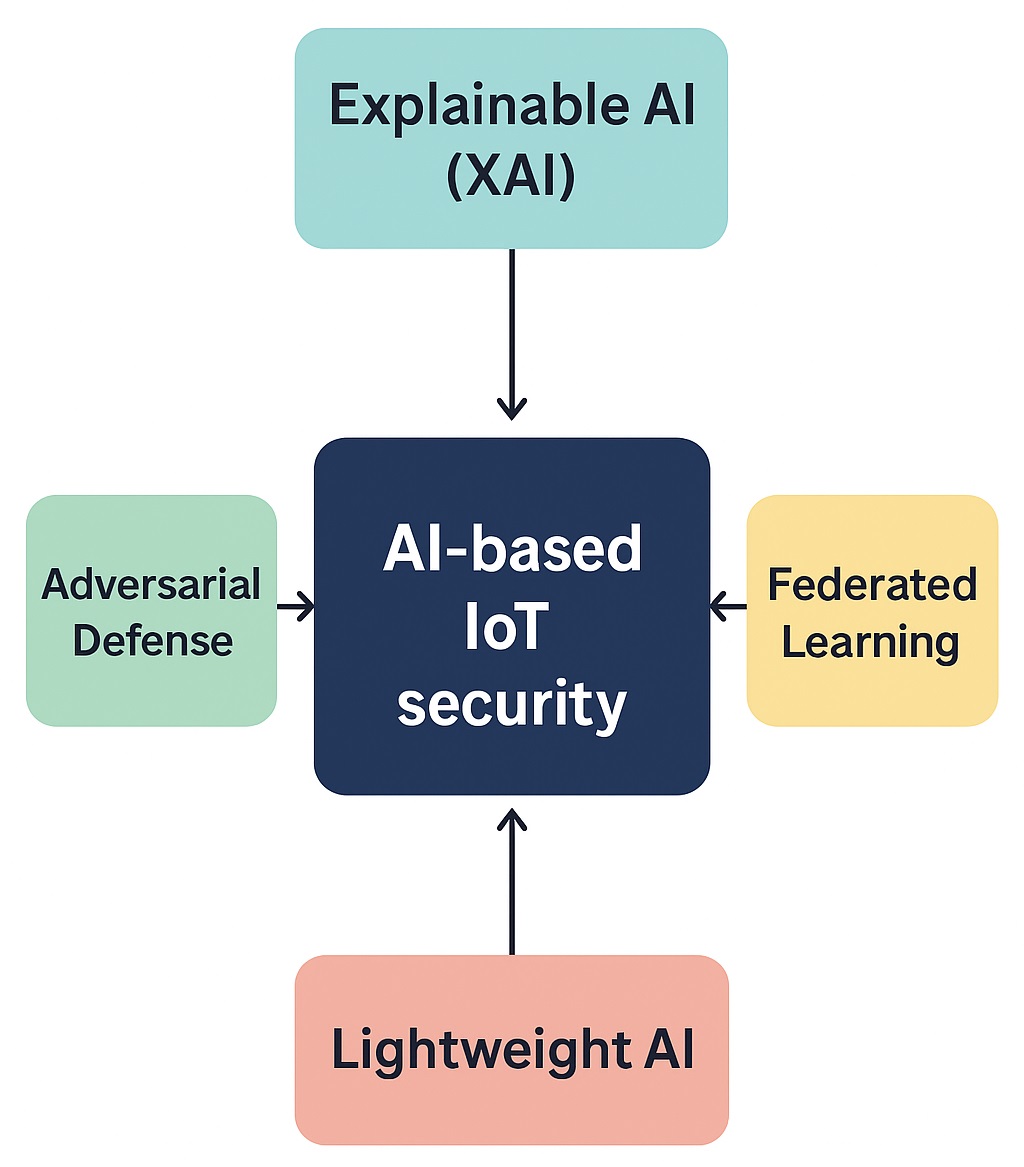
AI has emerged as both a safeguard and a potential threat to IoT security. While it strengthens anomaly detection, intrusion prevention, and predictive defences, it simultaneously creates new vulnerabilities through adversarial attacks and misuse. A balanced approach integrating explainable AI, adversarial defense, and lightweight models is essential to ensure resilient IoT ecosystems. Future research must focus on the duality of AI in IoT, developing hybrid frameworks that combine AI-driven intelligence with classical security measures. This review highlights both the opportunities and inherent risks, offering a roadmap for PhD-level inquiry and innovation in AI-driven IoT security.
References
Abomhara, M., & Køien, G. M. (2015). Security and privacy in the Internet of Things: Current status and open issues. Computer Networks, 77, 10-28.
Al-Garadi, M. A., Mohamed, A., Al-Ali, A., Du, X., Guizani, M. (2020). A survey of machine and deep learning methods for Internet of Things (IoT) security. IEEE Communications Surveys & Tutorials, 22(3), 1646-1685.
Chen, T. M., & Bridges, R. A. (2017). Automated behavioral analysis of malware: A case study of WannaCry ransomware. Journal of Information Security and Applications, 42, 24-36.
Doshi, R., Apthorpe, N., & Feamster, N. (2018). Machine learning DDoS detection for consumer IoT devices. IEEE Security and Privacy Workshops, 29-35.
Gubbi, J., Buyya, R., Marusic, S., & Palaniswami, M. (2013). Internet of Things (IoT): A vision, architectural elements, and future directions. Future Generation Computer Systems, 29(7), 1645-1660.
Khan, R., Khan, S. U., Zaheer, R., & Khan, S. (2012). Future Internet: The Internet of Things architecture, possible applications and key challenges. 10th International Conference on Frontiers of Information Technology.
Kolias, C., Kambourakis, G., Stavrou, A., & Gritzalis, S. (2017). DDoS in the IoT: Mirai and other botnets. Computer, 50(7), 80-84.
Liu, X., Yu, W., Griffith, D., & Golmie, N. (2018). Towards deep learning in industrial IoT security: Approaches and case studies. IEEE Internet of Things Journal, 5(4), 3209-3224.
Mosenia, A., & Jha, N. K. (2017). A comprehensive study of security of Internet-of-Things. IEEE Transactions on Emerging Topics in Computing, 5(4), 586-602.
Nguyen, T. N., Marchal, S., Miettinen, M., Fereidooni, H., Asokan, N., & Sadeghi, A. (2019). DÏoT: A federated self-learning anomaly detection system for IoT. IEEE ICDCS, 756-767.
Papernot, N., McDaniel, P., & Goodfellow, I. (2017). Practical black-box attacks against machine learning. Proceedings of the ACM on Asia Conference on Computer and Communications Security.
Sarker, I. H. (2022). Machine learning-based cybersecurity intrusion detection: State-of-the-art and future research directions. Journal of Big Data, 9(1), 1-41.
Shafique, K., Khawaja, B. A., Sabir, F., Qazi, S., & Mustaqim, M. (2020). Internet of Things (IoT) for next-generation smart systems: A review of security challenges, machine learning solutions, and future trends. IEEE Access, 8, 23022-23040.
Singh, J., Pasquier, T., Bacon, J., Ko, H., & Eyers, D. (2016). Twenty security considerations for cloud-supported Internet of Things. IEEE Internet of Things Journal, 3(3), 269-284.
Suo, H., Wan, J., Zou, C., & Liu, J. (2012). Security in the Internet of Things: A review. International Conference on Computer Science and Electronics Engineering, 3, 648-651.
Tang, Y., Mhamdi, E. M., Bellet, A., & Tommasi, M. (2019). Privacy-preserving machine learning in IoT: Threats and solutions. IEEE Internet of Things Journal, 6(3), 5400-5411.
Verma, P., & Ranga, V. (2019). Machine learning-based intrusion detection systems for IoT applications: A review. Journal of Information Security and Applications, 42, 95-104.
Xu, R., Lin, Y., & Luo, Y. (2021). Adversarial machine learning in IoT: A survey. IEEE Internet of Things Journal, 8(7), 5442-5459.
Yaqoob, I., Hashem, I. A. T., Ahmed, A., Kazmi, S. A., Hong, C. S. (2017). Internet of Things forensics: Challenges and future trends. Future Generation Computer Systems, 92, 395-411.
Zhang, Y., Deng, R. H., & Liu, J. K. (2018). Security and privacy in smart health: Efficient policy-hiding attribute-based access control. IEEE Internet of Things Journal, 5(3), 2130-2145.

 PDF Downloads:
257
PDF Downloads:
257 Open
Access -
Open
Access -