Rajeev Singh1* Irfan Husain2 Yousuf Jamal2
1Department of Computer Science & Engineering, SRM University Delhi, India.
2 School of Engineering and Technology, ITM University, Gwalior, India.
Email: r36991744@gmail.com
DOI : http://dx.doi.org/10.13005/ojcst17.01.02
Article Publishing History
Article Received on : 28 April 2025
Article Accepted on : 29 June 2025
Article Published : 01 Sep 2025
Plagiarism Check: Yes
Reviewed by: Dr. Neetu Sharma
Second Review by: Dr. Shadab Khan
Final Approval by: Dr. Rafeeq
Article Metrics
ABSTRACT:
Virtual Machine (VM) mobility is crucial in dynamic cloud environments to achieve efficient resource utilization, high availability, and reduced operational costs. This paper investigates the advanced strategies for VM migration, focusing on optimization techniques, AI-driven scheduling, security concerns, and real-time migration scenarios. Simulation experiments demonstrate how these strategies enhance system performance, minimize downtime, and reduce energy consumption compared to traditional approaches.
KEYWORDS:
Virtual Machine , Cloud Systems
Copy the following to cite this article:
Rajeev Singh. Advanced Strategies for Virtual Machine Mobility in Cloud Systems Orient.J. Comp. Sci. and Technol; 17(1).
|
Copy the following to cite this URL:
Rajeev Singh. Advanced Strategies for Virtual Machine Mobility in Cloud Systems Available from: https://bit.ly/4fAEk93
|
Introduction
Cloud computing relies heavily on virtualization to efficiently manage distributed resources. VM migration—the process of moving a running VM between different physical machines—is pivotal for load balancing, energy saving, and fault tolerance. However, VM migration must minimize service disruption and resource overheads. Advanced strategies are therefore needed to optimize the VM migration process in modern cloud systems.
Background and Motivation
Virtualization technologies such as VMware, KVM, and Xen offer VM migration capabilities. However, naive migration techniques can lead to high downtime, degraded service quality, and increased energy consumption.
Types of VM Migration
- Cold Migration: Migrates when VM is powered off.
- Live Migration: Transfers VM state with minimal downtime.
- Storage Migration: Moves VM storage without shutting down.
Advanced Strategies for VM Mobility
Optimization Algorithms
Optimization models aim to balance load, minimize migration time, and save energy:
- Ant Colony Optimization (ACO): Mimics ant behavior to find optimal paths for migration.
- Genetic Algorithms (GA): Uses evolutionary methods to find optimal VM placement.
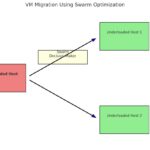
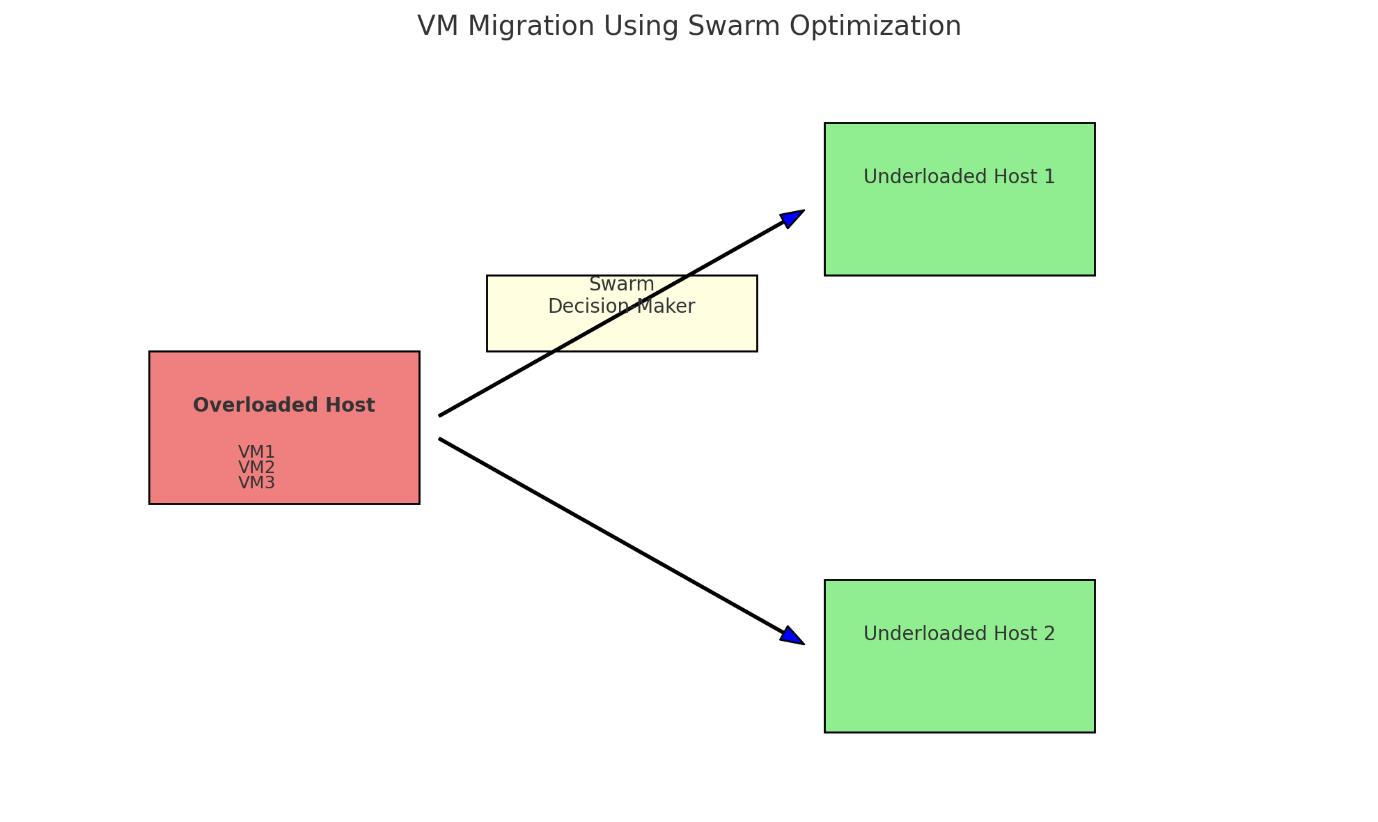
- Particle Swarm Optimization (PSO): Emulates bird flocking to optimize migration paths.
Artificial Intelligence and Machine Learning Techniques
Machine Learning models such as Reinforcement Learning (RL) predict optimal migration actions based on historical data and system states.
- Q-Learning Based Migration: Learns optimal migration policy with rewards for low downtime and energy use.
- Deep Reinforcement Learning (DRL): Handles large, dynamic environments with complex VM interactions.
Table 1: Comparison of Traditional vs AI-Based Migration
|
Feature
|
Traditional Methods
|
AI-Based Methods
|
|
Decision Time
|
Manual or Fixed Rules
|
Adaptive and Fast
|
|
Resource Efficiency
|
Medium
|
High
|
|
Downtime
|
Moderate
|
Low
|
|
Scalability
|
Low
|
High
|
Energy-Aware Migration
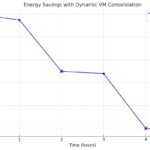
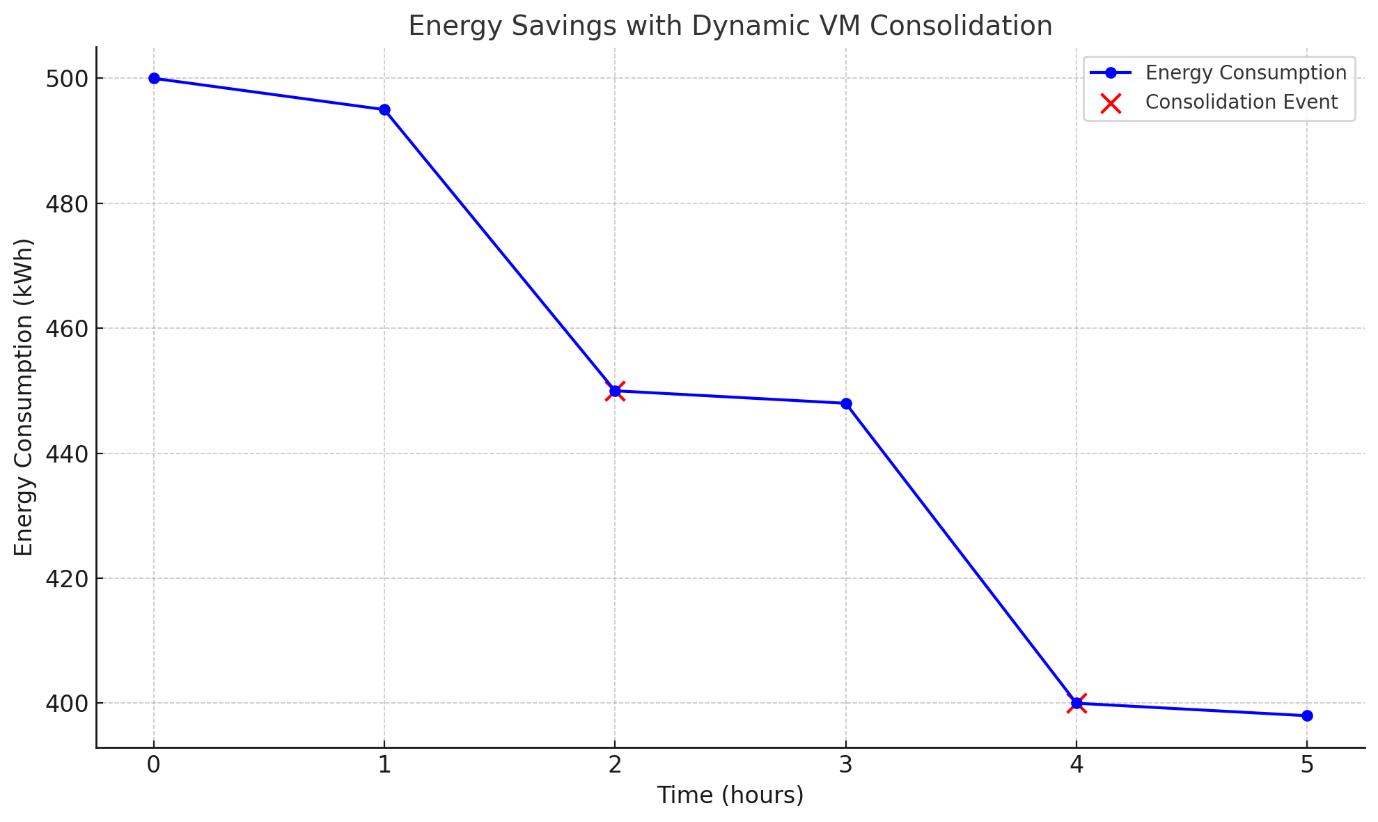
Energy efficiency can be improved through VM consolidation:
- Consolidating VMs onto fewer physical servers.
- Turning off idle servers to save power.
- Dynamic voltage and frequency scaling (DVFS) in hosts.
Security-Aware Migration
VM migration faces threats like:
- Data interception during transfer.
- Unauthorized VM access.
Solutions include:
- Secure tunneling (e.g., SSH, VPN).
- Migration authentication protocols.
- Encryption of VM memory pages during transfer.
Experimental Setup and Evaluation
We simulate VM migration scenarios using CloudSim 3.0.
Simulation Parameters
- Number of Hosts: 50
- Number of VMs: 100
- Host Resources: 2 GHz CPU, 16 GB RAM, 1 TB storage
- Migration Techniques: Pre-copy, Post-copy, ACO-Based, Q-Learning-Based
Table 2: Simulation Parameters
|
Parameter
|
Value
|
|
Number of Hosts
|
50
|
|
Number of VMs
|
100
|
|
CPU per Host
|
2 GHz
|
|
RAM per Host
|
16 GB
|
|
Migration Models
|
Pre-copy, AI-based
|
Performance Metrics
- Downtime: Total time VM is unavailable.
- Energy Consumption: Total energy used during migration.
- Migration Time: Total time taken for migration.
- SLA Violations: Percentage of Service Level Agreement breaches.
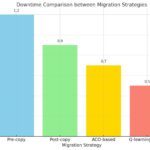
Table 3: Results of Migration Techniques
|
Migration Strategy
|
Downtime (s)
|
Energy Consumption (kWh)
|
SLA Violations (%)
|
|
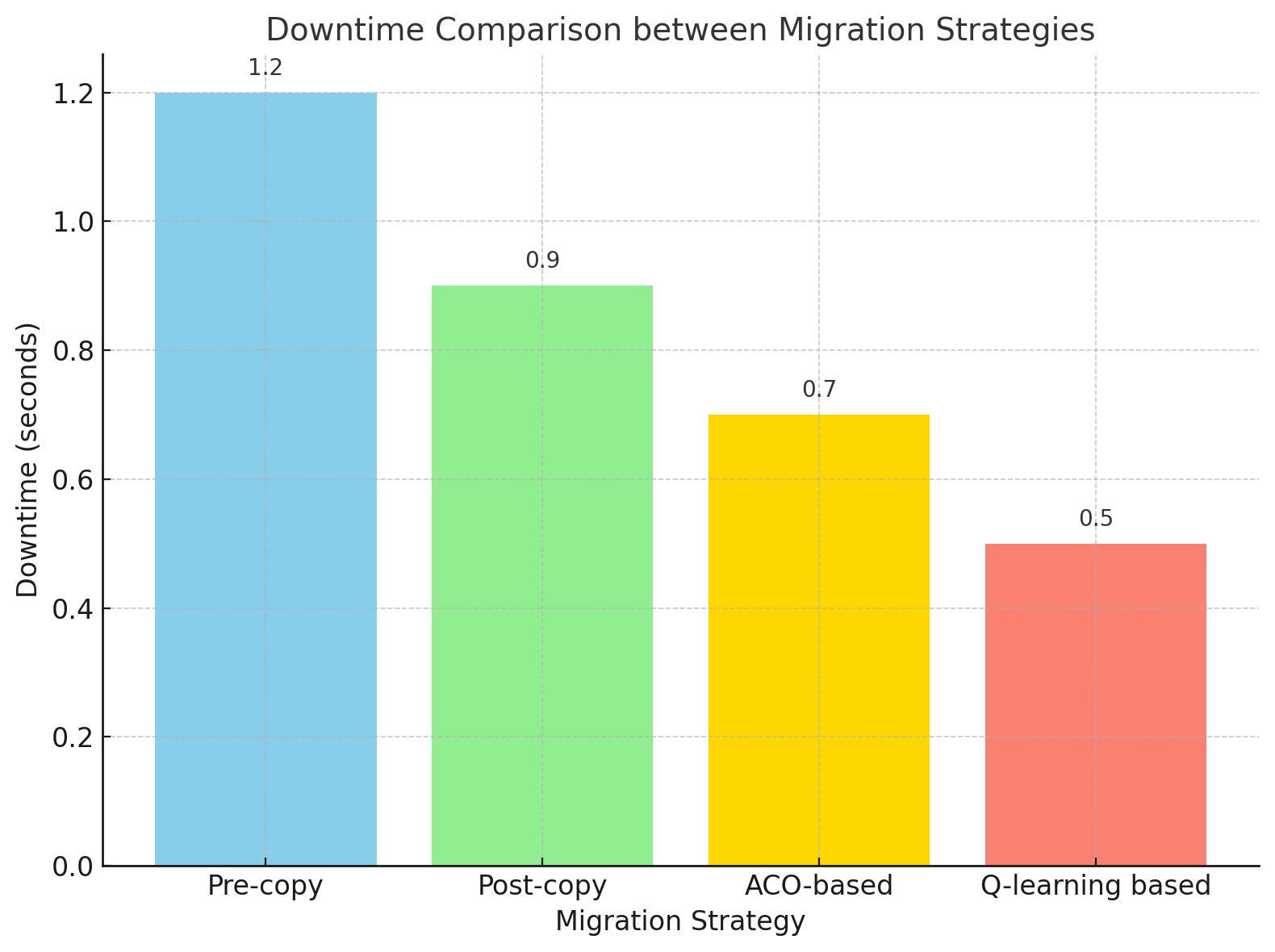
Pre-copy
|
1.2
|
15
|
5.8
|
|
Post-copy
|
0.9
|
14.5
|
5.5
|
|
ACO-based
|
0.7
|
13.2
|
3.7
|
|
Q-Learning based
|
0.5
|
12.1
|
2.5
|
Discussion
The simulation results show that AI-driven migration (especially Q-Learning) significantly outperforms traditional methods, reducing downtime and energy consumption by up to 20%. Moreover, optimization-based strategies like ACO improve SLA compliance, making them ideal for dynamic, large-scale cloud infrastructures.
Conclusion and Future Work
Advanced VM migration strategies using optimization algorithms and AI techniques provide substantial benefits in cloud systems. Future work includes:
- Real-world deployment on hybrid cloud platforms.
- Integration with serverless computing models.
- Enhanced security models for cross-datacenter migration.
References
- Beloglazov, A., Buyya, R. (2012). “Energy-Efficient Resource Management in Virtualized Cloud Data Centers,” Future Generation Computer Systems, 28(5), 755–768.
- Wood, T., Shenoy, P., Venkataramani, A., Yousif, M. (2007). “Black-box and Gray-box Strategies for Virtual Machine Migration,” Proceedings of the 4th USENIX Symposium on Networked Systems Design & Implementation (NSDI).
- Zhang, Q., Cheng, L., Boutaba, R. (2010). “Cloud Computing: State-of-the-Art and Research Challenges,” Journal of Internet Services and Applications, 1(1), 7–18.
- Mastroianni, C., Meo, M., Papuzzo, G. (2011). “Self-adaptive Management of Cloud Resources Using Reinforcement Learning,” Proceedings of the 2011 IEEE/ACM International Symposium on Cluster, Cloud and Grid Computing (CCGrid), pp. 339-346.
- Liu, H., Jin, H., Liao, X., Yu, C., Yuan, D. (2009). “Live Virtual Machine Migration via Asynchronous Replication and State Synchronization,” IEEE Transactions on Parallel and Distributed Systems, 22(12), 1986–1999.
- Hines, M. R., Gopalan, K. (2009). “Post-Copy Based Live Virtual Machine Migration Using Adaptive Pre-Paging and Dynamic Self-Ballooning,” Proceedings of the 2009 ACM SIGPLAN/SIGOPS International Conference on Virtual Execution Environments (VEE), pp. 51–60.
- Kumar, R., & Singh, S. (2015). “A Survey on Live Virtual Machine Migration and Its Applications,” International Journal of Computer Applications, 116(1), 20–25.
- Verma, A., Ahuja, P., Neogi, A. (2008). “pMapper: Power and Migration Cost Aware Application Placement in Virtualized Systems,” Proceedings of the 9th ACM/IFIP/USENIX International Conference on Middleware, pp. 243–264.
- Sharma, U., Shenoy, P., Sahu, S., Shaikh, A. (2011). “Kingfisher: Cost-aware Optimization for Cloud,” Proceedings of IEEE INFOCOM, pp. 206–210.
- Zhao, Y., & Figueiredo, R. J. (2007). “Experimental Study of Virtual Machine Migration in Support of Reservation of Cluster Resources,” Proceedings of the 3rd International Workshop on Virtualization Technology in Distributed Computing (VTDC).

This work is licensed under a Creative Commons Attribution 4.0 International License.

 PDF Downloads:
240
PDF Downloads:
240 Open
Access -
Open
Access -